|
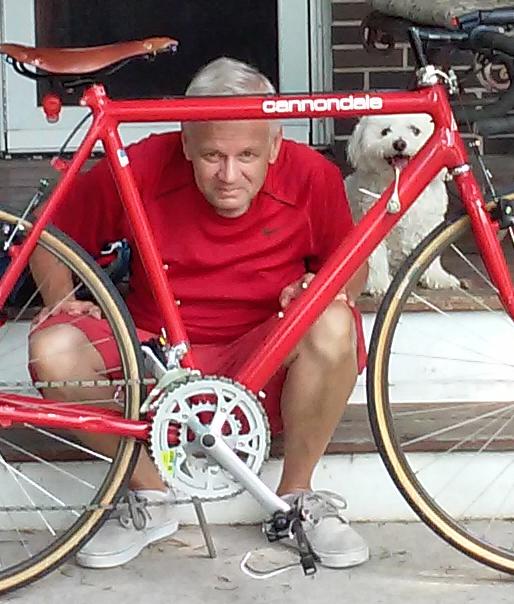
Above picture was from 2016 after
a ride on my 1990 Cannondale ST-600.
That is my best pal 'Fijit' doing the photo bomb
from behind me.Fijit was my hiking pal for almost
18 years until his passing in December of
2020. I miss our hikes Fiji-Monster........
For more on my
biking adventure see here.
First licensed the summer of 1971 as WN9HRP in Milwaukee
Wisconsin. My initial interests in radio began years
earlier with a Zenith Trans-Oceanic shortwave receiver ,
which I still have, that my dad purchased for my brother
Kenny. Kenny did quite a bit of SWL work, CB (back
when they used call signs) and later ham radio. He has
held the calls WN9VIC, WN9GYP, N0FGZ, KG0SV, W9KWB and
finally W4KWB when he retired to Harrison, TN.
Sadly I lost my brother to cancer on the 12th of
September, 2022. Without doubt, I owe my early
radio exposure to my father and brother. My dad
was always supportive of our radio hobby, but was
never personally interested in the hobby himself.
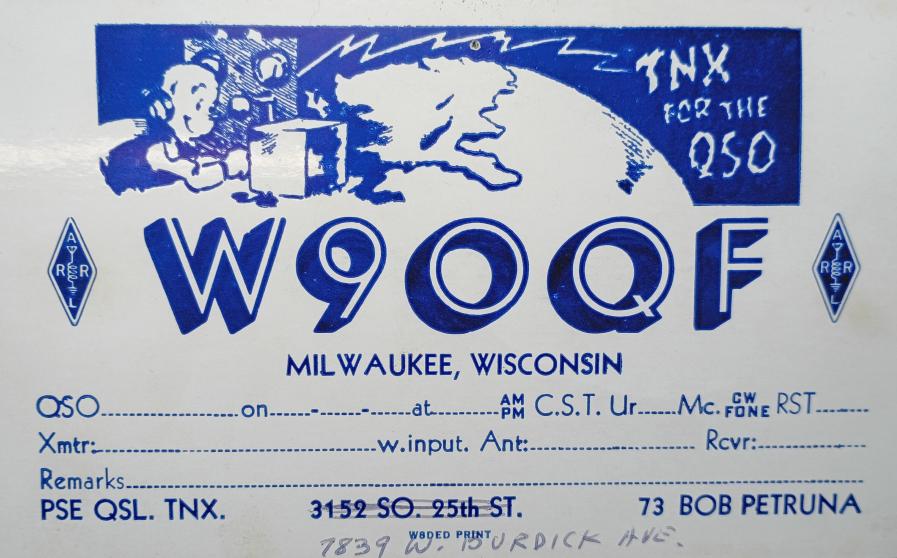
At twelve years of age I was given the Novice test by my
junior high school teacher Bob Petruna, W9OQF.
Bob was a great teacher and garnered respect from his
students. I'm not to sure how good Bob remembered his
Morse Code at the time. He just asked me to start
sending, and that I did for several minutes. Stopping me
with the statement "that will be enough" and he signed
the paper work. If memory serves me we had to send in
the document that indicated I could do five
words-per-minute and then wait for the FCC to send the
written test back to Bob. Code was one of my strong
points and I still love tuning around 80 meter CW at
night using my vintage National SW-3 regenerative
receiver. The SW-3 for those who haven't seen one was
just a little square black box regenerative receiver
that requires an external power supply and audio is
supplied via headphones only. Even today I can see why
it was such a popular receiver from the early 1930's
well into the 1940's. The Novice station utilized a
Heathkit DX-60B transmitter and a Hallicrafters SX-101
III receiver to separate antennas consisting of a long
wire for receive and various dipoles for transmit.
About six months after receiving my license I became
involved in a Ham Radio Explorer Scout post in
Milwaukee. Never having been involved with Cub Scouts
nor Boy Scouts, the Explorers offered me something that
the others couldn't. Basically it was a ham club for
teens and young adults. In those years peer pressure can
make-or-break a future. I was blessed to have been
involved with Explorer Post 373 and through that
organization have met and continue to associate with
many fine men and women to this day. It was through
their direct influence that moved me toward engineering
school and my resulting career. Continued involvement
with the post through high school and to a lesser extent
college, eventually in the role of an advisor. In later
years it became harder and harder to get youth interest
in the post and the ham radio activites and for the most
part it was disbanded. However, it does live on in-form
via The Miller Valley Amateur Radio Club in Milwaukee.
Although now just a ham club, it still tailors
activities and efforts toward the Milwaukee area youth.
I couldn't conclude my writing about Post 373 without
passing along my thanks to all those who I have had the
privilege to know from the group, including Art
McGlothlin WA9AWJ (SK) who was the driving force behind
the establishment and continuation of the post during
all my years of involvement.
In 1973, having passed my General at the traveling FCC
office in Milwaukee, my dad purchased me a SSB radio.
So, a used Swan 350 soon occupied the center spot in the
shack. By March of 1975 I worked my way up to the Extra
class license. These were junior and senior high days so
I had more time on my hands to play and study
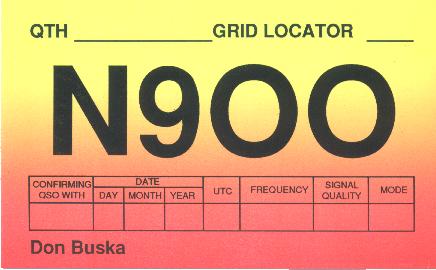
radio. In 1977 I received my current call sign
N9OO.
Through the years I've always managed to stay in touch
with the ham radio community and activities. Although
there were times when activity was low, I still kept up
with what was going on via the ham magazines. Been a
life member of the ARRL since high school and also a
life time subscriber to 73 magazine from around that
same time frame. (NOTE
- I outlived 73 Magazine which stopped publication in
October of 2003) For what was paid back then,
they both have paid for themselves many times over.
In 1989 I got bit by the VHF and above weak signal (SSB
& CW) bug. Picked up an older Yaesu FTV-250 2-meter
transverter and wired it up so it would function with my
ICOM IC-745 transceiver. Added a homebrew gasfet preamp
and a 160 watt brick amp to it. Achieved VUCC on
2-meters and have around 35 states confirmed. I
currently have a Yaesu FT-726R for 50MHz, 144MHz and
432MHz operations. I am less active on the
VHF/UHF bands after the digital modes started taking
over though.
In February of 1994 I picked up the
equipment that has held me captivated since seeing them
in the old QST's read when I was 10 years old. I'm
talking Collins here! My station is still home to a
Collins S-Line (75S-3C, 32S-3A, 30L-1 and 312B-4). What
joy this equipment is. This is what started my
adventures into the world of vintage ham equipment,
called boatanchors (BA's) by those in the know! I won't
get into all the equipment purchased since being
infected with the BA bug, but if you look thru my
station pictures here on my website you'll see it is
very addicting.
I figure that I have enough
refurbishing and building to do on all the BA's that
I've acquired to last me until the year 2050 or so.
You'd think that would keep me away from the
swapmeets.... yeah right! I can't even keep up with my
online pictures with the ever changing station
acquisitions.
Radio and Professional Related
Affiliations
American Radio Relay League (ARRL) - Life member
Antique Wireless Association (AWA) - Life Member
AM International (AMI)
The James Millen Society (JMS)
On the bio-professional side, received
a 1980 BSEE degree from The Milwaukee School of
Engineering. MSOE played a very important part in the
early years of radio communications in Milwaukee. For
more information on MSOE's radio history click here!.
After graduation, I spent a few years in sunny
California (LA beach cities) having fun and even fooling
a couple of employers into thinking I was there to do
real work.... Hungout at Hughes Aircraft designing test
systems for the F/A-18 jet fighter radar system. Two
years after that I was at Mattel Electronics designing
integrated circuits for add-ons to their Intellivision
video game system. Mattel was loosing money big time and
stayed in business for only 10 months after arriving. It
was fun while it lasted! The next six months were spent
enjoying the sun and living off of unemployment
insurance. All-in-all California was a great time and I
have fond memories of those days. I stay in contact with
many of my friends who are still there via email.
In 1984 I moved back to the mid-west and went to work
for Advantest America. Advantest is a Japanese
based company that manufactures test equipment for the
RF and optical field. In addition, they are the worlds
largest manufacturer of test systems for integrated
circuits (IC's). I worked in their IC tester division
(ATE) as a manager of the National Support Center
located in Buffalo Grove, Illinois.
In 2006 I formed DA Buska Engineers LLC
to provide consulting, development and design
engineering to the RF and ATE industry. I am,
however, still a cheese-head since my home QTH is
Kenosha, Wisconsin, which is on the south-east corner of
the state, on the Illinois-Wisconsin border. We
are the last stop on the Chicago commuter train!
During 2014 in an attempt to get into
better physical shape, I started bicycle riding.
This was done in conjunction, and after about a six
month start, switching to a lower net carbohydrate
diet. After I had lost my first 30 lbs I had a new
found discovery of energy that had been absent for a
long time. Over the next year I had lost more than
60 lbs and worked my way up to riding around 20 miles
per day either on the road or on a trainer
inside. Although, I don't bike ride every
day my rides still average in the 30-50 mile
range. To read more about my bike riding and my
interest in the restoration and use of vintage 1970-80's
steel bikes click here.
|